Wednesday, March 12, 2008

Pinching Off a Leprechaun


St. Patrick's day is approaching and I was thinking about all the customs attached to the holiday. What immediately comes to mind in this business is green beer. Love or hate the idea, putting coloring in beer can be fun and interesting, not only for the pretty green color while drinking but also the after effects.

First though, I thought about the history of the holiday's relics and how green became the defacto St. Patrick's day color. It started with the leprechaun, which is actually one of the fairies of ancient Irish mythology. He was feared because he hid from human view, but he was also revered because of his riches (pot 'o' gold). The leprechaun was later adopted by St. Patrick as a symbol of God. Like God, the leprechaun is hidden from view and has great riches for those who find Him (pot 'o' eternal life). Because the Irish believed that the leprechaun used the rich green countryside to conceal himself, the color green became associated with him as well as all things that have to do with St. Patrick and his day.

Drinking a bunch of beer also has its roots in the rituals of St. Patrick's day. There is more beer consumed in Ireland on St. Patrick's Day than there is on any other day of the year. This may be a practice carrying on St. Patrick's honoring of Brigid, the Celtic goddess of fire with "poteen" an Irish beer made from potatoes. St. Patrick is also credited with bringing the art of distilling to Ireland.

As far a green beer goes, it wasn't until the Irish settled in Boston, and faced ethnic discrimination that they chose to show their Irish pride by using the color green for all things Irish. Thus began the American tradition of green beer and wearing green. On a side note, pinching people who did not wear green was a reminder that leprechauns would sneak up on those who could be seen on this day and in order to remain hidden, and avoid the leprechauns, you must hide yourself by wearing green. Or maybe it was just a good excuse to cop a feel and talk about your green underwear.


Speaking of green underwear, some people have found that drinking a lot of green beer can turn your uh, ah, fecal matter, ahem, ah, green. There is a good reason for that. One of the dyes used in green food coloring, (FDA Blue #5) when metabolized in sufficient quantities (you might have to drink a butt-load, Ha Ha) combines with bile and forms a brilliant green color. This phenomenon is harmless, and does not happen to everybody who ingest blue #5. So if you indulge in green beer this St.Patty's day and you're still crappin' brown, relax, there's nothing physically wrong with you. But maybe a better choice would be to drink a nice Irish Stout instead.

never trust The Sober Brewer
Jerry Gnagy

Wednesday, February 27, 2008

Pepe le Pew Walks Into a Bar and Orders a Corona and Asparagus

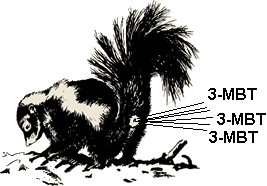
Picture yourself on a bright sunny day about to enjoy a bottle of imported beer, you pop the top and catch a whiff, and wonder if a skunk had just sprayed you. There is a good reason for this... the same compound that makes skunk spray smell so bad is the same compound that is in "skunked" beer. So how did the skunk get into the bottle?

It is a chemical reaction triggered by light. Skunky beer flavor is attributed to the compound 3-methylbut-2-ene-1-thiol or for easier notation furfuryl mercaptan. This is the same compound (mercaptan) that is found is skunk spray. We humans have a very low flavor threshold for mercaptan, we can detect its presence in quantities as small as .004 micrograms per liter. When beer is exposed to bright sunlight, significant quantities of mercaptan can form in mere minutes.


Specifically, what happens is riboflavin, which is produced by yeast during fermentation, absorbs energy from light at wavelengths of 350 to 500 nanometer. The riboflavin transfers the energy to iso-alpha acids (bittering compounds produced by boiling hops) which release free radicals that react with yeast derived sulfur compounds. Probably not coincidentally, amber colored glass, blocks the offending light wavelengths under 500 nanometers, which is why most beers don't have the skunky smell. While beers like Corona (clear glass packaging) and Heineken (green glass) have mercaptan as a central flavor characteristic. This is also why people are encouraged to stick limes in Corona bottles, in order to cover up the skunk stench. If you want to try an experiment, buy two six-packs of Heineken, one in cans and one in green glass bottles. Set them both in the sunlight for 10 minutes then taste them. The beer in the bottle should have a noticeable "skunky" smell compared to the cans.


Where else can we find this mercaptan? We find it in a step up from Corona... our urine. Specifically that smelly urine you get after eating asparagus. The culprit in asparagus is asparagusic acid, which produced methyl mercaptan in urine. A strange fact about this is that only 40% of the UK population produces this chemical in their urine, while 100% of the French population does. Even stranger is that 90% of the Israeli population and 75% of the Chinese, have no ability to smell the mercaptan-laced urine. Which begs the question, do people who like Corona also lack the ability to smell mercaptan, or do they just like the smell of skunk spray and urine? Who's to say.

never trust The Sober Brewer
Jerry Gnagy
What Brewers do - 04 - Unloading Grain Deliveries

Unloading Pallets of grain is always fun, especially when they forget to send us a truck with a lift gate.


Friday, February 8, 2008

The Sober Brewer's Super Bowl Comercial

Unfortunately we were a little short on the funds necessary to purchase air time for our advert...